
Criminal Court Records in Murray County
A criminal court record is the case file the Court Clerk opens once the State files charges in District Court. It is not a single page. It is a running file that holds the charging document, every motion, each court date, and the judge's orders. The Court Clerk at the Murray County Courthouse keeps these files and is the office that issues certified copies. Each file carries a case number, the named defendant, and the State of Oklahoma as the charging party. Felony and misdemeanor cases both live here. The file grows as the case moves, so the docket is the best place to confirm the current status of a charge.
Murray County sits in Oklahoma's Twentieth Judicial District, and the District Court hears its criminal cases. That court handles both felony and misdemeanor matters, along with civil, family, probate, and many traffic cases. Felony cases carry a CF prefix, such as CF-2024-1, while misdemeanors use a CM prefix. City ticket and ordinance cases are different. Those go to the Sulphur or Davis Municipal Court and may not show in the District Court case search. For a closer look at how the charges themselves are filed and changed, see the Murray County arrest records and court charges. For the full range of filings, the court records page maps the whole system.
How to Search Murray County Criminal Records
The main search channel is the Oklahoma State Courts Network, known as OSCN. It offers free public docket search and lists Murray County District Court in its court dropdown. When a case does not appear there, On Demand Court Records is the second channel and also lists Murray in its court list. Both let a reader search by defendant name or by case number.
- Open the OSCN docket search and choose Murray County District Court in the County or Court dropdown.
- Search by the defendant's full legal name, or enter the case number using the prefix and year format, such as CF-2024-1 for a felony or CM for a misdemeanor.
- Narrow the results by case type and filing date so the right defendant and the right case rise to the top.
- Open the case to read the docket, the charges, each hearing, and the disposition or sentence.
- If the case is missing from OSCN, run the same search in ODCR with Murray selected, then request a certified copy from the Court Clerk for older files or documents not posted online.
A court docket confirms what was filed in Murray County, but it is not a statewide rap sheet. For a full criminal history across Oklahoma, the report comes from the state bureau, not the court file. The Court Clerk handles certified copies and files that never reached the online system. That office answers at 580-622-3223 and sits at 1001 W. Wyandotte Avenue in Sulphur, with a mailing address at P.O. Box 684, Sulphur, OK 73086.
Stages of a Murray County Criminal Case
A criminal case moves through set stages, and each one leaves a mark in the court file. The docket shows the date of each step with short text describing the event. Reading the stages in order is the fastest way to tell where a case stands.
Case flow: Charges Filed › Arraignment › Pretrial and Motions › Plea or Trial › Disposition › Sentencing
The case opens when the District Attorney files an information, the formal charging document. District 20, led by Melissa Handke, files charges for Murray County, and the DA decides which counts move forward. At arraignment the court states the charges and the defendant enters a plea of guilty, not guilty, or no contest. The plea entry is one of the first key lines in the record.
Pretrial brings motions, the exchange of evidence, and bond decisions. Most cases end with a plea rather than a trial. When a case does go to trial, a judge or jury weighs the evidence and returns a verdict. The disposition then records the result of each count, and at sentencing the judge sets the penalty. A sentence can include jail or prison, probation, fines, court costs, and restitution.
Reading Murray County Dispositions and Sentences
The disposition is the outcome of a charge, and it is the line most people look for first. Common entries include guilty, not guilty, dismissed, and nolo contendere, which means no contest. A dismissal can be with prejudice, meaning the count cannot be refiled, or without prejudice, meaning it may return.
Oklahoma also uses deferred and suspended sentences, and the difference matters. A deferred sentence delays judgment while the defendant meets conditions. Finishing those terms can lead to a dismissal and a later expungement. A suspended sentence is a conviction, but part or all of the jail time is held back as long as the conditions hold. The sentence line shows the length, any probation, and the money owed in fines, costs, and restitution.
Read the whole docket, not one line. A charge can be amended, reduced, or dropped before the final disposition lands.
What a Murray County Criminal Record Shows
A criminal case file in Murray County collects a standard set of fields. Public views vary by case type, and some details stay sealed or redacted. The table below lists the fields a reader most often needs.
| Field | What It Shows |
|---|---|
| Case Number | The court's unique ID, built from a prefix, year, and sequence, such as CF-2024-1 for a felony or CM for a misdemeanor. |
| Defendant | The accused person's name, with the State of Oklahoma listed as the charging party. |
| Charges | Each count, its statute, the offense label, and any later amendment, reduction, or dismissal. |
| Plea | The defendant's formal answer to each count, such as guilty, not guilty, or no contest. |
| Disposition | The current or final result of each count, from dismissal to conviction. |
| Sentence | The penalty ordered, including jail or prison, probation, fines, court costs, and restitution. |
Other entries fill out the file. The docket lists the assigned judge, the attorneys, bond settings, hearing dates, motions, continuances, and payment plans. Personal identifiers such as Social Security numbers, full birth dates, and victim addresses are kept out of public view.
Statewide Criminal History Reports
A court file covers one case in one county. A full criminal history across Oklahoma is a separate record held by the Oklahoma State Bureau of Investigation. The OSBI runs a name-based request portal called CHIRP, short for the Criminal History Information Request Portal. This report is not the same thing as a county court file.
Statewide reports start at the OSBI's Criminal History Information Request Portal, where a registered user can order a name-based report.
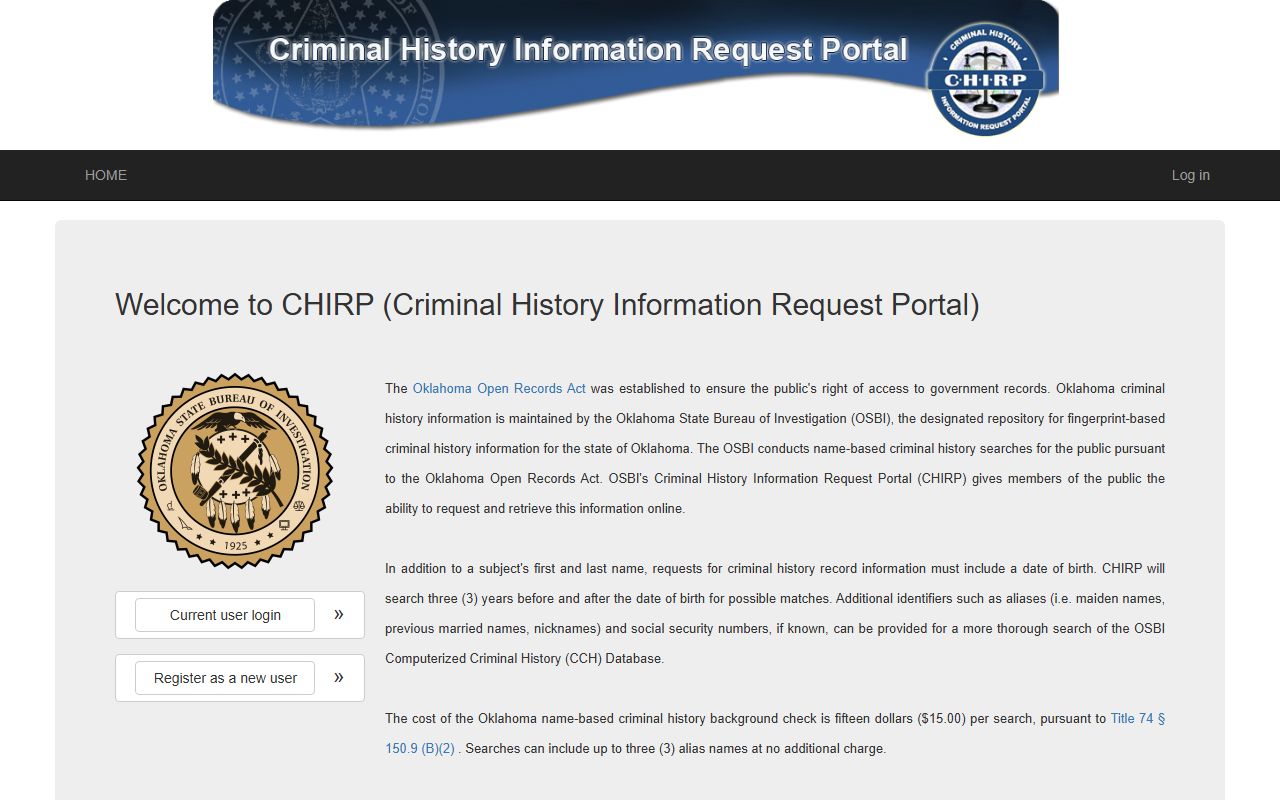
A CHIRP report pulls from records across the state, so it can list cases that no single county docket would show. That makes it the right tool for a background review rather than a one-case lookup.
The OSBI also accepts requests by mail, fax, and in person, and the agency posts step-by-step instructions for each route. The OSBI's guide to requesting a background check lists the online, mail, fax, and in-person options side by side.
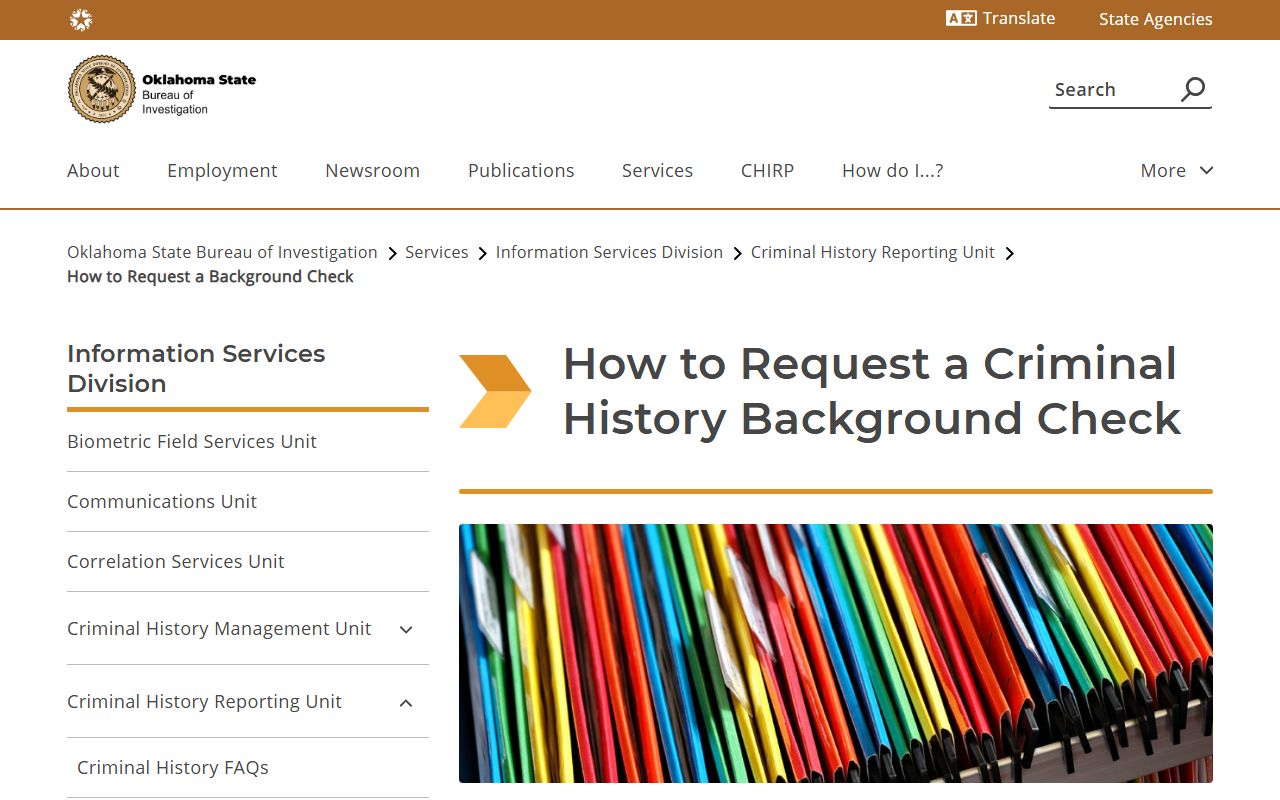
Choosing the right method up front avoids a rejected request and a second trip. After a sentence to state prison, custody moves out of the county, and the Oklahoma Department of Corrections offender lookup tracks sentenced state inmates apart from the county jail and the court file.
Charges vs. Convictions
Being charged is not the same as being convicted, and the court record keeps the two apart. A charge is an accusation the State files. A conviction is the result after a plea or a verdict. A criminal court record can show charges that were dropped, dismissed, or that ended in acquittal, and none of those is a conviction.
| Charge | Conviction | |
|---|---|---|
| Stage | Accusation | Verdict or plea |
| Burden of Proof | Probable cause | Beyond a reasonable doubt |
| Status | Case still open | Final judgment entered |
| Public Record | Yes | Yes |
A name on a charge line means the State filed counts. It does not prove guilt. Note: read the disposition before drawing any conclusion, because a filed charge can still be reduced, dismissed, or beaten at trial.
Public Access to Murray County Records
Oklahoma treats most court records as open. The state Open Records Act sets the rule that public bodies keep records open unless a law makes a record confidential. Criminal case files fall under that policy, which is why OSCN and ODCR can post dockets for the public to read.
Key Statutes:
Oklahoma 51 O.S. § 24A.5 - Public bodies must keep records open to inspection and copying unless a specific law makes the record confidential.
Oklahoma 51 O.S. § 24A.8 - Law enforcement agencies must release basic arrest and incident information, within the limits the statute sets.
When a record is sealed or expunged, the public portal may show nothing or only a stub entry. In those cases, access can require a court order rather than a simple search.
Sealed vs. Expunged Murray County Records
Two terms cause the most confusion: sealed and expunged. In Oklahoma the practical effect is close, because expungement seals a record from public access rather than destroying every copy. The right to seal or expunge a criminal record comes from state law.
Oklahoma's expungement statute, 22 O.S. § 18, sets who qualifies and what sealing does.
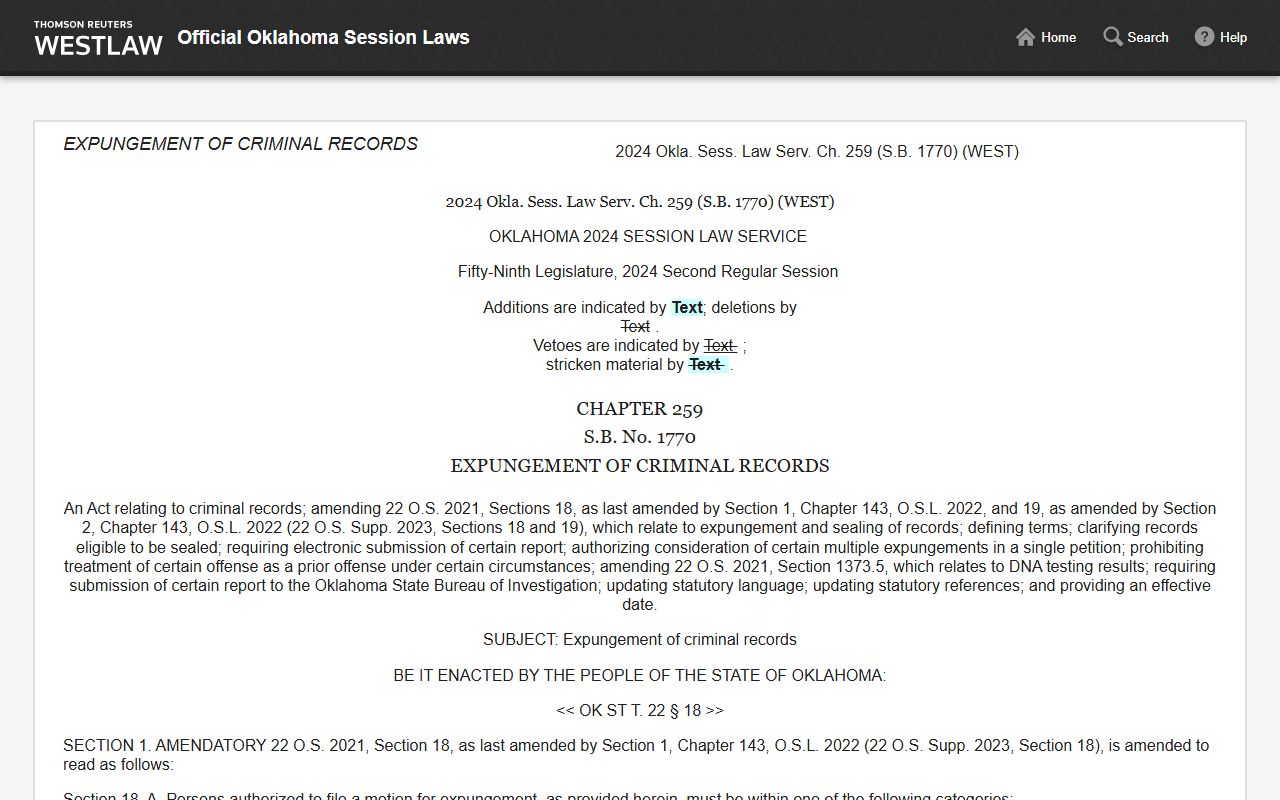
The statute makes clear that a sealed file is removed from ordinary public view, not erased from every government system.
| Sealed | Expunged | |
|---|---|---|
| Visibility | Hidden from public view | Hidden from public view and treated as never having occurred for most purposes |
| Law Enforcement | Limited access | Limited access retained by courts and agencies |
| How It Happens | By statute or court order | By petition in District Court under 22 O.S. § 18 |
| Eligibility | Set by statute and court order | Depends on case outcome, conviction type, and waiting period |
A Murray County expungement starts by checking eligibility, then filing a petition in the District Court and giving notice to agencies such as the prosecutor, the arresting agency, and the OSBI. If the judge grants it, those agencies seal the covered record. Note: the court filing fee for an expungement was not found in Murray County sources, so confirm the current cost with the Court Clerk before filing.
Indigent Defense and Prosecution
Every criminal case has two sides in the record: the State and the defense. The District Attorney for District 20 prosecutes Murray County cases and files the charges. A defendant who cannot afford a lawyer may receive appointed counsel through the court.
Court-appointed defense in Oklahoma runs through the Oklahoma Indigent Defense System, the statewide agency for indigent defense.

The appointment is ordered by the court, so a defendant raises the request at an early hearing rather than contacting the agency cold. Both the prosecutor and the defense attorney appear by name in the docket once they enter the case.
Restricted Murray County Criminal Records
Not every criminal matter is open. Juvenile cases, including delinquency and deprived-child files, are generally restricted. Access can be limited to the parties, their attorneys, certain agencies, or anyone the court allows by order. Adoption and mental-health commitment files carry similar limits.
Sealed and expunged cases drop out of public search under 22 O.S. § 18. Active investigations, sealed search warrants, and protected victim information may also be withheld or redacted. When the online portal shows a gap, the Court Clerk can explain whether a file is sealed, restricted, or simply not yet posted. For warrant questions tied to an open case, the Sheriff's Office and the District Court docket are the places to check before drawing any conclusion.